Tuesday, May 2, 2017

Rain Delay


We had a rain day at the Stoddart Avenue Community Garden on Saturday.   After going three straight weeks without at least an inch of rain per week, we’ve received over three inches in just four days.  (This reminds me of our dry months last year when we would receive an entire month’s rain in the last few days of the month).  After having May weather in April, we’re now having March weather in May.  Go figure.   I have trays and trays of seedlings in my patio portable greenhouse that are too tall to return to my basement grow station (with grow lights), but too tender to stay outside indefinitely in this weather.   I may have to move the greenhouse to the garage in the evenings. 


Tree pollen season is back upon us and our friendly downspouts are again clogging on schedule.  Despite 2.3 inches of rain before yesterday, our big tank was only half full when I checked it on Sunday because the downspout drain was again clogged.   After unclogging it, I checked the other downspout, which was ok and the tall tank seemed to be full.  However, with our neighbor now having its own large tank near our tall tank, it is a challenge to check that downspout with my ladder.  The oak pollen clogged my own downspout and had covered my lawn and patio.  My neighbor is blaming it for coloring her concrete.  Sigh.   I took some photos, where you can see it (even though the winds had bunched it more together than it had been a few days earlier).  When the black walnut tree next door starts to pollinate, we can count on having to unclog our downspouts at the Garden on a weekly basis until it dissolves.

On Wednesday, I weeded my own plot a bit (which I’m sure that my gardeners think is well overdue).   Our speakers last fall at the meetings of the Greater Columbus Growing Coalition have been preaching the importance of soil microbes.  We spend a lot of time feeding our plants (with fertilizer), but they also need living soil and those microrganisms need something to eat during our non-growing season.  This is one of the reasons farmers plants cover crops in the Fall to overwinter a field or garden. It’s also one of the reasons to cut your spent plants off at the lower stem instead of pulling it out by its roots.  (Another reason is to minimize erosion when the soil is unprotected from the wind).   Those roots give the soil something to snack on over the winter and this is as important as the soil nutrients.   Remember how disappointed I was that Marcel had pulled out all of the roots we had left behind on closing day?  Well, she knew better than to touch my plot.  In addition to leaving behind stems and some fall crops (like kale and leeks), in October I had planted Walnut Creek Seeds Winter Kill seed mix.  This group of seeds are designed to be planted in September and to die back by the time we’re ready to plant in the Spring.  It contains a mixture of oats, winter pea, maple pea, radishes, etc.  The speakers also advocated no-till farming (which only Sabrina practices at the SACG).

 I also let chickweed take over my plot.  It has shallow roots, dies back when it gets hot and does not get very tall.  I figure, it can’t hurt and it keeps the soil in place (instead of blowing away when it’s unprotected).  Chickweed got its name because chickens eat it in the winter when everything else has died.  OSU did a nice blog post on it a few weeks ago.   I roll it up as I do my spring planting to make room for new seeds and seedlings. 

I also mowed the lawn again.  One of our new gardeners has been ignoring my weekly updates and even the email I sent with all of our lock combinations.  He argued that I only sent him some of the combinations and not the one for the tank.  Sadly for him, everyone got the same email and no one else has had any problems.  (Unlike him, they took my advice to write them down before they forgot them).   And we haven’t locked the tanks in a few years.  I’m annoyed that he’s too lazy to even try the combinations he already has before complaining and blaming me for his poor character.  I sent him the combinations again and now -- even though he has spent no more than 4 hours in his entire life volunteering at the SACG --  he’s been calling me names by email and won't let it go.  Just random thoughts.  As someone observed to me about her own brother on Sunday:  he lives in the present and tends to get stuck there.  Considering that we only have two rules at the SACG and one of them is not to annoy me or cause problems for me, I don’t think he’s going to be long for the SACG.  We’ll see if he performs his assigned weekly chore this week.   The Garden’s mentally and physically exhausting enough without having to deal with high maintenance drama queens like this.  Mother Nature is the only drama queen I can accommodate.

I also photographed our blueberry bushes, which were also in flower.  I can only hope that we get as many blueberries as they had flowers because half of them were looking fantastic.  The other half, not so much.   Rayna’s been concerned about them.  When I was getting ready for opening day, I discovered that someone had thrown a heavy landscaping stone onto one of the bushes.  Why?!  What could that bush have done to deserve it?!  It doesn’t have thorns.  Gee whiz. 

I had planned to weed on Saturday and dig up some of our overpopulation of dandelions.  Even though Phil Kelly kept insisting that it wasn’t going to rain on the half-marathon on Saturday (during live newscasts no less), the Accuweather radar was clearly showing a significant storm barreling down on us.   Even though a lot of storms bypass us entirely, I decided to trust the radar over a biased tv weatherman whose station was co-sponsoring a big event downtown.  I’m glad that I did so because it started pouring shortly after I would have arrived. 
It apparently dried out enough on Sunday for the SACG's neighbors to get their landscaping groove on.  When I stopped by to check on the downspouts and mow our lawn (again), I discovered that several of them had focused on Cherry Street (our alley).  The folks across the street pulled weeds and edged it.  Our next door neighbors similarly pulled weeds and edged it.  They asked me how far I thought they could push into the alley . . . maybe they are considering creating their own curb like ours and planting flowers along side their sidewalk.  I took photos of them working and rewarded them with Earth Day Columbus Volunteer Rewards.  (Isn't April 30 Arbor Day anyway)?   I also encouraged them to pull the weeds growing outside our curb on our side of the alley.  They just laughed.   A girl can dream . . . .

Despite my invitation for them to join us (and my warning about its abundant population of deer and groundhogs), Life Vineyard Church has decided to build its own community garden near Alum Creek and Main Street – just a couple blocks southeast from the SACG.   My, what a difference money makes.  When we broke ground at the SACG, we had $200 donated by Thrivent for Lutherans.   I had to get everything else donated or pay for it out of my own pocket.  We were blessed to have gotten donated compost from Kurtz Brothers, fence from Home Depot, cedar from Trudeau Fence and Bowden fence (which we used to cut into stakes and to build our front and back gates), seeds from the old Livingston Seed Company, wood chips from Wright’s Tree Service, four rain barrels from Rain Brothers (which were later upgraded by the City to two giant rain cisterns), and the compost delivery fee from Dublin attorney Christopher Hogan, etc.  We dug all of our fence posts by hand with shovels.  Pastor Nick rented an auger and purchased all kinds of lumber and wire fencing.   Local Matters help him build the beds (with lots of labor help from the very handy men in the congregation).  In a few short hours, the field went from being empty to the construction of a fabulous fence surrounding 12 raised beds.   (Those beds could have been filled by dirt if the women had wheelbarrows and soil to fill them while the men built the fence, but we lent moral support).  

Nick even had fencing to put in the bottom of each bed to keep critters from burrowing up into them, but I didn’t see that as much of a risk.  He realizes that deer can still jump in if they want, but who wants to build a 10 foot fence (other than Grace Church on Shady Lane)?   I saw that they could use a gate and offered them our wonderful nine-year old front gate(which was replaced last year by our lovely new trellis).   I could tell that they were a bit underwhelmed by its age and lacked my sentimental attachment to it.  I encouraged them to remove the top trellis (and one guy suggested maybe just replacing the top trellis).   He really just wanted to paint it a bright color, which made me shudder.  The hardware was also starting to rust, so I have a feeling that they will replace the hardware, remove/replace the top trellis section and powerwash it before they install it. 

Instead of digging a trench and burying the wire fence a foot down (to discourage groundhogs), I convinced Nick that it would be easier to bury the fence in donated wood chips.  It would also help with edging.   (Granted, soil would do the same thing and then could be used to support flower beds, but I have my doubts that the deer population would leave the flowers alone and soil is more expensive than donated chips).  We’ve never had a trouble with groundhogs burrowing under our fence (which we also supported by lining up bricks along both sides of it which we had dug out of our lot), but we do not have anywhere near the number of grounhogs that live along Alum Creek.

And Nick fed everyone with Donatos pizza and had a cement mixer there to pour into all of the fence post holes.  (We aren’t allowed to use cement at the SACG per the terms of our City lease and as faithful readers know, this has made it challenging to keep the fence posts upright at times).     I never got to use my saw or any of my power tools.   The other men had much better tools anyway and lots of electricity.  And, as Nick likes to rub it in, they have running water, too.   But, as I told him, we have more space and bigger plots.   Much bigger plots.  I also rewarded Nick and his volunteers with Earth Day Columbus volunteer rewards (since not all of my volunteers showed up for our cold Earth Day earlier in the month).

I should mention how nice it was to just hang with the other ladies and not be in charge and running around like a chicken with my head cut off making sure that forward momentum continued on several fronts while all of the volunteers were there. Unlike Nick, I aslso didn't have to spend Monday returning all of the rentals and loaners.  I could just go home and sip my chardonnay.
I had hoped to start planting peppers this week, but I think I will have to wait another week for the weather to warm up.  If it dries out a bit, we might weed the vacant plots this Saturday and prepare to plant corn in Rayna’s old plot (to be followed by pole beans and zucchini).    I have resorted to using row covers for my cold crops because the flea beetles have been eating them something fierce and the moths/caterpillars aren’t far behind.   I even bought some extra to also cover the two food pantry plots where we’re growing the popular kale and collards).    They don’t really flower, so I don’t have to remove them to make way for bees like I will for the squash.  I’m just wondering if I anchored them well enough for this wind when I only used a few bricks . . . . . .

Rain Delay


We had a rain day at the Stoddart Avenue Community Garden on Saturday.   After going three straight weeks without at least an inch of rain per week, we’ve received over three inches in just four days.  (This reminds me of our dry months last year when we would receive an entire month’s rain in the last few days of the month).  After having May weather in April, we’re now having March weather in May.  Go figure.   I have trays and trays of seedlings in my patio portable greenhouse that are too tall to return to my basement grow station (with grow lights), but too tender to stay outside indefinitely in this weather.   I may have to move the greenhouse to the garage in the evenings. 


Tree pollen season is back upon us and our friendly downspouts are again clogging on schedule.  Despite 2.3 inches of rain before yesterday, our big tank was only half full when I checked it on Sunday because the downspout drain was again clogged.   After unclogging it, I checked the other downspout, which was ok and the tall tank seemed to be full.  However, with our neighbor now having its own large tank near our tall tank, it is a challenge to check that downspout with my ladder.  The oak pollen clogged my own downspout and had covered my lawn and patio.  My neighbor is blaming it for coloring her concrete.  Sigh.   I took some photos, where you can see it (even though the winds had bunched it more together than it had been a few days earlier).  When the black walnut tree next door starts to pollinate, we can count on having to unclog our downspouts at the Garden on a weekly basis until it dissolves.

On Wednesday, I weeded my own plot a bit (which I’m sure that my gardeners think is well overdue).   Our speakers last fall at the meetings of the Greater Columbus Growing Coalition have been preaching the importance of soil microbes.  We spend a lot of time feeding our plants (with fertilizer), but they also need living soil and those microrganisms need something to eat during our non-growing season.  This is one of the reasons farmers plants cover crops in the Fall to overwinter a field or garden. It’s also one of the reasons to cut your spent plants off at the lower stem instead of pulling it out by its roots.  (Another reason is to minimize erosion when the soil is unprotected from the wind).   Those roots give the soil something to snack on over the winter and this is as important as the soil nutrients.   Remember how disappointed I was that Marcel had pulled out all of the roots we had left behind on closing day?  Well, she knew better than to touch my plot.  In addition to leaving behind stems and some fall crops (like kale and leeks), in October I had planted Walnut Creek Seeds Winter Kill seed mix.  This group of seeds are designed to be planted in September and to die back by the time we’re ready to plant in the Spring.  It contains a mixture of oats, winter pea, maple pea, radishes, etc.  The speakers also advocated no-till farming (which only Sabrina practices at the SACG).

 I also let chickweed take over my plot.  It has shallow roots, dies back when it gets hot and does not get very tall.  I figure, it can’t hurt and it keeps the soil in place (instead of blowing away when it’s unprotected).  Chickweed got its name because chickens eat it in the winter when everything else has died.  OSU did a nice blog post on it a few weeks ago.   I roll it up as I do my spring planting to make room for new seeds and seedlings. 

I also mowed the lawn again.  One of our new gardeners has been ignoring my weekly updates and even the email I sent with all of our lock combinations.  He argued that I only sent him some of the combinations and not the one for the tank.  Sadly for him, everyone got the same email and no one else has had any problems.  (Unlike him, they took my advice to write them down before they forgot them).   And we haven’t locked the tanks in a few years.  I’m annoyed that he’s too lazy to even try the combinations he already has before complaining and blaming me for his poor character.  I sent him the combinations again and now -- even though he has spent no more than 4 hours in his entire life volunteering at the SACG --  he’s been calling me names by email and won't let it go.  Just random thoughts.  As someone observed to me about her own brother on Sunday:  he lives in the present and tends to get stuck there.  Considering that we only have two rules at the SACG and one of them is not to annoy me or cause problems for me, I don’t think he’s going to be long for the SACG.  We’ll see if he performs his assigned weekly chore this week.   The Garden’s mentally and physically exhausting enough without having to deal with high maintenance drama queens like this.  Mother Nature is the only drama queen I can accommodate.

I also photographed our blueberry bushes, which were also in flower.  I can only hope that we get as many blueberries as they had flowers because half of them were looking fantastic.  The other half, not so much.   Rayna’s been concerned about them.  When I was getting ready for opening day, I discovered that someone had thrown a heavy landscaping stone onto one of the bushes.  Why?!  What could that bush have done to deserve it?!  It doesn’t have thorns.  Gee whiz. 

I had planned to weed on Saturday and dig up some of our overpopulation of dandelions.  Even though Phil Kelly kept insisting that it wasn’t going to rain on the half-marathon on Saturday (during live newscasts no less), the Accuweather radar was clearly showing a significant storm barreling down on us.   Even though a lot of storms bypass us entirely, I decided to trust the radar over a biased tv weatherman whose station was co-sponsoring a big event downtown.  I’m glad that I did so because it started pouring shortly after I would have arrived. 
It apparently dried out enough on Sunday for the SACG's neighbors to get their landscaping groove on.  When I stopped by to check on the downspouts and mow our lawn (again), I discovered that several of them had focused on Cherry Street (our alley).  The folks across the street pulled weeds and edged it.  Our next door neighbors similarly pulled weeds and edged it.  They asked me how far I thought they could push into the alley . . . maybe they are considering creating their own curb like ours and planting flowers along side their sidewalk.  I took photos of them working and rewarded them with Earth Day Columbus Volunteer Rewards.  (Isn't April 30 Arbor Day anyway)?   I also encouraged them to pull the weeds growing outside our curb on our side of the alley.  They just laughed.   A girl can dream . . . .

Despite my invitation for them to join us (and my warning about its abundant population of deer and groundhogs), Life Vineyard Church has decided to build its own community garden near Alum Creek and Main Street – just a couple blocks southeast from the SACG.   My, what a difference money makes.  When we broke ground at the SACG, we had $200 donated by Thrivent for Lutherans.   I had to get everything else donated or pay for it out of my own pocket.  We were blessed to have gotten donated compost from Kurtz Brothers, fence from Home Depot, cedar from Trudeau Fence and Bowden fence (which we used to cut into stakes and to build our front and back gates), seeds from the old Livingston Seed Company, wood chips from Wright’s Tree Service, four rain barrels from Rain Brothers (which were later upgraded by the City to two giant rain cisterns), and the compost delivery fee from Dublin attorney Christopher Hogan, etc.  We dug all of our fence posts by hand with shovels.  Pastor Nick rented an auger and purchased all kinds of lumber and wire fencing.   Local Matters help him build the beds (with lots of labor help from the very handy men in the congregation).  In a few short hours, the field went from being empty to the construction of a fabulous fence surrounding 12 raised beds.   (Those beds could have been filled by dirt if the women had wheelbarrows and soil to fill them while the men built the fence, but we lent moral support).  

Nick even had fencing to put in the bottom of each bed to keep critters from burrowing up into them, but I didn’t see that as much of a risk.  He realizes that deer can still jump in if they want, but who wants to build a 10 foot fence (other than Grace Church on Shady Lane)?   I saw that they could use a gate and offered them our wonderful nine-year old front gate (which was replaced last year by our lovely new trellis).   I could tell that they were a bit underwhelmed by its age and lacked my sentimental attachment to it.  I encouraged them to remove the top trellis (and one guy suggested maybe just replacing the top trellis).   He really just wanted to paint it a bright color, which made me shudder.  The hardware was also starting to rust, so I have a feeling that they will replace the hardware, remove/replace the top trellis section and powerwash it before they install it. 

Instead of digging a trench and burying the wire fence a foot down (to discourage groundhogs), I convinced Nick that it would be easier to bury the fence in donated wood chips.  It would also help with edging.   (Granted, soil would do the same thing and then could be used to support flower beds, but I have my doubts that the deer population would leave the flowers alone and soil is more expensive than donated chips).  We’ve never had a trouble with groundhogs burrowing under our fence (which we also supported by lining up bricks along both sides of it which we had dug out of our lot), but we do not have anywhere near the number of grounhogs that live along Alum Creek.

And Nick fed everyone with Donatos pizza and had a cement mixer there to pour into all of the fence post holes.  (We aren’t allowed to use cement at the SACG per the terms of our City lease and as faithful readers know, this has made it challenging to keep the fence posts upright at times).     I never got to use my saw or any of my power tools.   The other men had much better tools anyway and lots of electricity.  And, as Nick likes to rub it in, they have running water, too.   But, as I told him, we have more space and bigger plots.   Much bigger plots.  I also rewarded Nick and his volunteers with Earth Day Columbus volunteer rewards (since not all of my volunteers showed up for our cold Earth Day earlier in the month).

I should mention how nice it was to just hang with the other ladies and not be in charge and running around like a chicken with my head cut off making sure that forward momentum continued on several fronts while all of the volunteers were there. Unlike Nick, I aslso didn't have to spend Monday returning all of the rentals and loaners.  I could just go home and sip my chardonnay.
I had hoped to start planting peppers this week, but I think I will have to wait another week for the weather to warm up.  If it dries out a bit, we might weed the vacant plots this Saturday and prepare to plant corn in Rayna’s old plot (to be followed by pole beans and zucchini).    I have resorted to using row covers for my cold crops because the flea beetles have been eating them something fierce and the moths/caterpillars aren’t far behind.   I even bought some extra to also cover the two food pantry plots where we’re growing the popular kale and collards).    They don’t really flower, so I don’t have to remove them to make way for bees like I will for the squash.  I’m just wondering if I anchored them well enough for this wind when I only used a few bricks . . . . . .

Sunday, April 23, 2017

Lonely on the Range


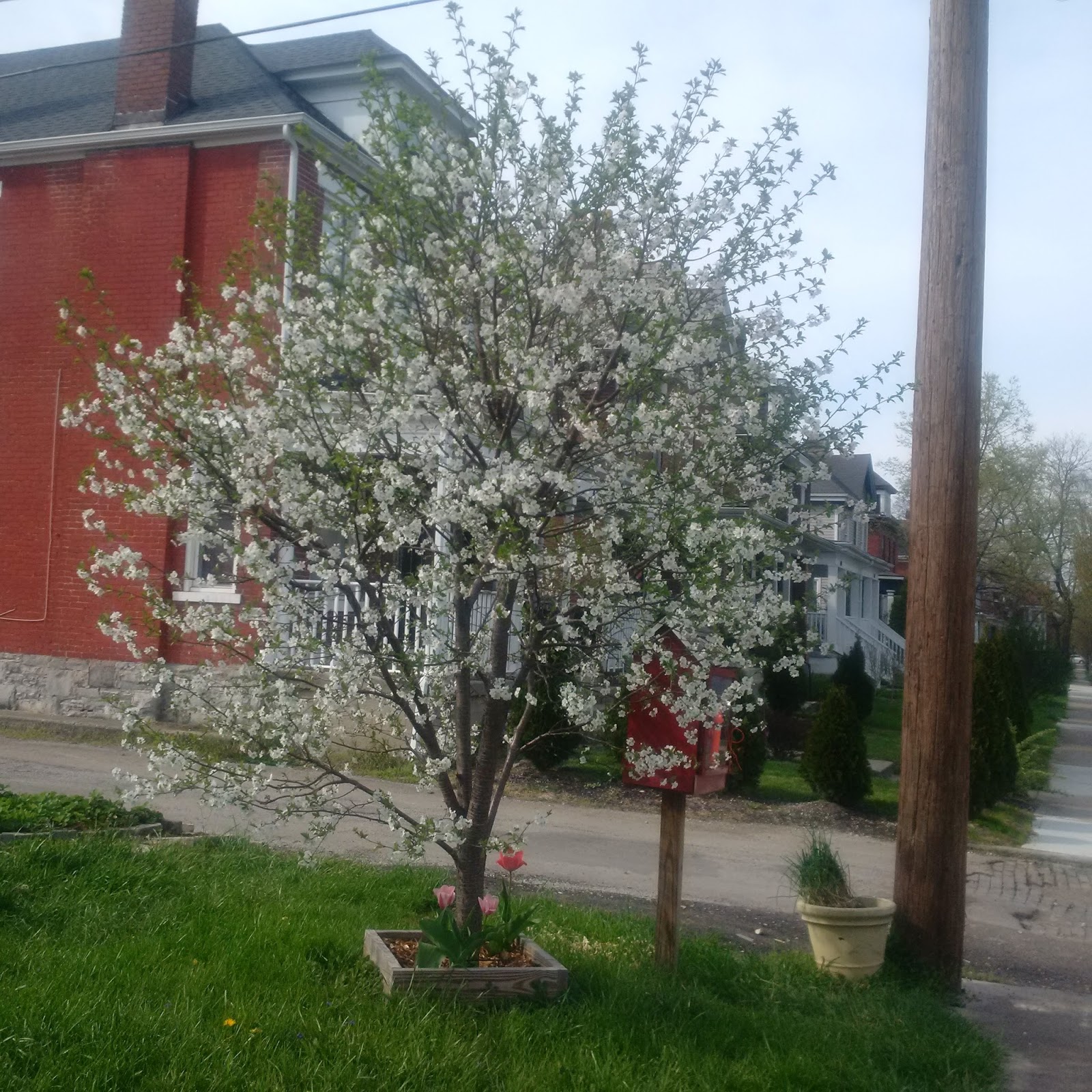
It’s been a little lonely at the Stoddart Avenue Community Garden the last few weeks – as it is every April.  The mornings are cold and the skies cloudy.   However, our cherry trees looked SPECTACULAR a few weeks ago and attracted lots of bees.   I look a lot of photos.  Little cherries, strawberries and raspberries are already forming – a little early in my book.  Our berries do not look as thick as in past years and I’m a little concerned that this might not be the best year to have a berry festival in early June as a fundraiser.  We may have barely enough berries for ourselves;-)  Our peach trees looked to have survived the March freeze, but when I was staking two of the leaning trees today, I noticed some freeze damage on the leaves.  Sigh.

Last Saturday, I left on time and didn’t do that much.  I planted some onions, lettuce, leeks, beets, turnips, cilantro and parsley, watered everything, and transplanted a some coneflowers (from my backyard) and a few perennials that I picked up during the annual DeMonye’s perennial sale.   (I really need to pick up some cat mint and, darn it, didn’t write it down and bought a couple of everything else . . .).   I didn’t assign any chores for April (because we had two groups of volunteers), but the grass was looking a little tall.  Heroic Ken (in addition to donating a brand spanking new green gas mower) also donated an older reel mower (which I sharpened a few weeks ago and put in our shed).  I took it out and tried to mow our lawn.  Darn that Stan.  He did such a fabulous job aerating and tending our lawn over the last two years that the grass was too tall and thick for me to easily mow it.  It took me forever to mow just the front lawn and I didn’t even try to do much of the side yard (aka Block Watch lot). 

On Wednesday, I watered some more.  The rest of the country (and state) may be getting plenty of rain, but the drought has started early on the Near East Side.  We haven’t gotten at least an inch of rain per week in several weeks.  Alexi and Isaiah came by.  Alexi made the mistake of asking if there was anything I needed.  Since you ask . . . . . (which I’m certain that he’ll never do again), I asked him to mow the lawn.  It was looking pretty shaggy.  He agreed and started by mowing the Block Watch lot next door.  He had met Block Watch Barb earlier in the week and she told him how the Block Watch (i.e., mostly her and her heroic husband Frank) mow the two corner lots most weeks.  I had planned to only stay about 45 minutes, but I could hardly leave while he was still mowing.  (We stow the mower in a neighbor’s shed and I have one of the only keys).   Meanwhile, Isaiah started preparing the soil in their plot (by digging out the ever present bricks that we are still digging out by hand NINE years after breaking ground) and planting some seedlings and seeds.   Since I had to stick around, I planted some more flowers from the flats I purchased at the DeMonye’s sale.   I also weeded a few of the flower beds. 


Little Jaden from across the street then came over to start planting in his own bed (now that he's finally six).  His older sister Micayla has gardened with us since she was his age, but decided that she is now too cool to get dirty.  So, he picked one of the platform raised beds (which did not have any weeds in it) and only wanted to plant fruit.  It's too early for melons, but against my better judgment, we transplanted a row of some volunteer strawberries (from outside our patch).  I also talked him into carrots and beets.  His father likes peppers, so we'll plant some of them eventually.  He vetoed lettuce and greens. Then, he watered everything in three times.  (Most kids like to water, but a full watering can weighs almost as much as he does).   Amy also stopped by with her husband to water her seedlings.  Finally, when I got home at dusk, I mowed my own yard with my reel mower.

On Friday, Seth from the City Land Bank, sent us all a hateful email threatening to terminate lot licenses (aka leases).  As I have heard over the years, some community gardens are not as conscientious as we are about keeping their lawns mowed.   Seth had inspected most of the gardens on Friday and was freaked out by the height of the grass at many of them.    I emailed him that we had just mowed on Wednesday (THANK YOU ALEXI) and had actually mowed it four times already in April.   He emailed back that the SACG was also one of the few to have already broken ground for the season this year.  (Most community gardens don’t break ground until Mother’s Day weekend because their volunteers are not excited about cold weather gardening and don’t care too much about losing out on cold weather crops like potatoes, spinach, bok choy, lettuce and peas that should really be planted in March and April).

Before I mulched it yesterday
When I arrived yesterday morning, I was SHOCKED that the dandelions in the Block Watch lot that Alexi mowed just days earlier were already up to my calves.  The grass was short, but those darn weeds ruined the whole look.   Luckily, I had killed most of the dandelions in our front lawn a few years ago, so we still looked tidy.  But, I mowed our front lawn and part of the side lawn with the reel mower anyway.  The grass and the yellow flowers got cut, but not much else.  Sigh.     I had meant to refill Urban Connections gasoline can (since we have used it the last couple of times we’ve mowed, but I forgot to bring my gas can.  I went home to get it and discovered that it was almost empty.  So, I’ll refill it tomorrow). 


Yesterday morning, I hung the Chore Chart and the Garden map in the shed.  Then, I tied up two of the leaning peach trees to help them grow straight.   Next, I transplanted a bunch of raspberries and then trellised the berries in my plot to keep them from growing over my spinach, bok choy and pea crops.  I transplanted more flowers and weeded most of the flower beds.  I also watered the neighbor plots, the newest fruit trees, the food pantry plots, and my plot.  I planted a  food pantry plot of my remaining cold crop seedlings and added a row (and then some) of onions. I weeded more in the flower beds, the blueberry turrets and the food pantry plot and transplanted some volunteer cosmos flowers and holly hocks.   I finally mulched the newest fruit trees and the round tulip/lilly bed south of the Garden before calling it a day at 4 p.m.   Herschel Craig stopped by to visit Kimball Farms next door (which was supposed to be having their major work day this morning), but no one was there.  They must have been at their other site.  

After 2 p.m. Taylor and Alyssa came by to water and plant some more.  They decided to plant potatoes this year, so we had a chat about that.  (I’m not planting them for the first time this year because they take so much space).   We also talked about interplanting onions in various spaces.   It is recommended, for instance, to plant onions between rows of lettuce.  They have different root systems and the onions will continue to grow after your lettuce has been harvested and bolted with the summer's heat.  Also, planting onions and garlic between them will supposedly deter aphids (not that I've ever had an aphid problem before August).  Planting carrots between lettuce rows is also recommended.  I've even seen a recommendation to plant lettuce (in the fall) in each space left by a harvested onion. I explained that I'm not a big fan of planting onions next to tall plants because they tend to get shaded out (with as close as we tend to plant at the SACG).   After Taylor left, Carly and Ashley (or Rachel) came by.

Joy decided that it was not enough to share a plot with Rachel.  So, she put in 3 hours of work equity by turning some of our compost and picking up litter in our neighborhood so that she could ALSO have her own 100 square foot plot. 

Block Watch Barb stopped by to tend their flower beds.  They had apparently also mowed that lot yesterday (with their electric mower).  I stuck some Earth Day volunteer rewards under her windshield when she wasn’t looking.

My day was not yet over.  I turned my own compost bin , repaired and ran a soaker hose from one of my three rain barrels, and mulched my front flower beds with 10 bags of mulch.  I had been slow cooking white beans all day (to make soup), but was too tired to cook.  So, off to Chipotle to use my Earth Day volunteer rewards.

Lonely on the Range


It’s been a little lonely at the Stoddart Avenue Community Garden the last few weeks – as it is every April.  The mornings are cold and the skies cloudy.   However, our cherry trees looked SPECTACULAR a few weeks ago and attracted lots of bees.   I look a lot of photos.  Little cherries, strawberries and raspberries are already forming – a little early in my book.  Our berries do not look as thick as in past years and I’m a little concerned that this might not be the best year to have a berry festival in early June as a fundraiser.  We may have barely enough berries for ourselves;-)  Our peach trees looked to have survived the March freeze, but when I was staking two of the leaning trees today, I noticed some freeze damage on the leaves.  Sigh.

Last Saturday, I left on time and didn’t do that much.  I planted some onions, lettuce, leeks, beets, turnips, cilantro and parsley, watered everything, and transplanted a some coneflowers (from my backyard) and a few perennials that I picked up during the annual DeMonye’s perennial sale.   (I really need to pick up some cat mint and, darn it, didn’t write it down and bought a couple of everything else . . .).   I didn’t assign any chores for April (because we had two groups of volunteers), but the grass was looking a little tall.  Heroic Ken (in addition to donating a brand spanking new green gas mower) also donated an older reel mower (which I sharpened a few weeks ago and put in our shed).  I took it out and tried to mow our lawn.  Darn that Stan.  He did such a fabulous job aerating and tending our lawn over the last two years that the grass was too tall and thick for me to easily mow it.  It took me forever to mow just the front lawn and I didn’t even try to do much of the side yard (aka Block Watch lot). 

On Wednesday, I watered some more.  The rest of the country (and state) may be getting plenty of rain, but the drought has started early on the Near East Side.  We haven’t gotten at least an inch of rain per week in several weeks.  Alexi and Isaiah came by.  Alexi made the mistake of asking if there was anything I needed.  Since you ask . . . . . (which I’m certain that he’ll never do again), I asked him to mow the lawn.  It was looking pretty shaggy.  He agreed and started by mowing the Block Watch lot next door.  He had met Block Watch Barb earlier in the week and she told him how the Block Watch (i.e., mostly her and her heroic husband Frank) mow the two corner lots most weeks.  I had planned to only stay about 45 minutes, but I could hardly leave while he was still mowing.  (We stow the mower in a neighbor’s shed and I have one of the only keys).   Meanwhile, Isaiah started preparing the soil in their plot (by digging out the ever present bricks that we are still digging out by hand NINE years after breaking ground) and planting some seedlings and seeds.   Since I had to stick around, I planted some more flowers from the flats I purchased at the DeMonye’s sale.   I also weeded a few of the flower beds. 


Little Jaden from across the street then came over to start planting in his own bed (now that he's finally six).  His older sister Micayla has gardened with us since she was his age, but decided that she is now too cool to get dirty.  So, he picked one of the platform raised beds (which did not have any weeds in it) and only wanted to plant fruit.  It's too early for melons, but against my better judgment, we transplanted a row of some volunteer strawberries (from outside our patch).  I also talked him into carrots and beets.  His father likes peppers, so we'll plant some of them eventually.  He vetoed lettuce and greens. Then, he watered everything in three times.  (Most kids like to water, but a full watering can weighs almost as much as he does).   Amy also stopped by with her husband to water her seedlings.  Finally, when I got home at dusk, I mowed my own yard with my reel mower.

On Friday, Seth from the City Land Bank, sent us all a hateful email threatening to terminate lot licenses (aka leases).  As I have heard over the years, some community gardens are not as conscientious as we are about keeping their lawns mowed.   Seth had inspected most of the gardens on Friday and was freaked out by the height of the grass at many of them.    I emailed him that we had just mowed on Wednesday (THANK YOU ALEXI) and had actually mowed it four times already in April.   He emailed back that the SACG was also one of the few to have already broken ground for the season this year.  (Most community gardens don’t break ground until Mother’s Day weekend because their volunteers are not excited about cold weather gardening and don’t care too much about losing out on cold weather crops like potatoes, spinach, bok choy, lettuce and peas that should really be planted in March and April).

Before I mulched it yesterday
When I arrived yesterday morning, I was SHOCKED that the dandelions in the Block Watch lot that Alexi mowed just days earlier were already up to my calves.  The grass was short, but those darn weeds ruined the whole look.   Luckily, I had killed most of the dandelions in our front lawn a few years ago, so we still looked tidy.  But, I mowed our front lawn and part of the side lawn with the reel mower anyway.  The grass and the yellow flowers got cut, but not much else.  Sigh.     I had meant to refill Urban Connections gasoline can (since we have used it the last couple of times we’ve mowed, but I forgot to bring my gas can.  I went home to get it and discovered that it was almost empty.  So, I’ll refill it tomorrow). 


Yesterday morning, I hung the Chore Chart and the Garden map in the shed.  Then, I tied up two of the leaning peach trees to help them grow straight.   Next, I transplanted a bunch of raspberries and then trellised the berries in my plot to keep them from growing over my spinach, bok choy and pea crops.  I transplanted more flowers and weeded most of the flower beds.  I also watered the neighbor plots, the newest fruit trees, the food pantry plots, and my plot.  I planted a  food pantry plot of my remaining cold crop seedlings and added a row (and then some) of onions. I weeded more in the flower beds, the blueberry turrets and the food pantry plot and transplanted some volunteer cosmos flowers and holly hocks.   I finally mulched the newest fruit trees and the round tulip/lilly bed south of the Garden before calling it a day at 4 p.m.   Herschel Craig stopped by to visit Kimball Farms next door (which was supposed to be having their major work day this morning), but no one was there.  They must have been at their other site.  

After 2 p.m. Taylor and Alyssa came by to water and plant some more.  They decided to plant potatoes this year, so we had a chat about that.  (I’m not planting them for the first time this year because they take so much space).   We also talked about interplanting onions in various spaces.   It is recommended, for instance, to plant onions between rows of lettuce.  They have different root systems and the onions will continue to grow after your lettuce has been harvested and bolted with the summer's heat.  Also, planting onions and garlic between them will supposedly deter aphids (not that I've ever had an aphid problem before August).  Planting carrots between lettuce rows is also recommended.  I've even seen a recommendation to plant lettuce (in the fall) in each space left by a harvested onion. I explained that I'm not a big fan of planting onions next to tall plants because they tend to get shaded out (with as close as we tend to plant at the SACG).   After Taylor left, Carly and Ashley (or Rachel) came by.

Joy decided that it was not enough to share a plot with Rachel.  So, she put in 3 hours of work equity by turning some of our compost and picking up litter in our neighborhood so that she could ALSO have her own 100 square foot plot. 

Block Watch Barb stopped by to tend their flower beds.  They had apparently also mowed that lot yesterday (with their electric mower).  I stuck some Earth Day volunteer rewards under her windshield when she wasn’t looking.

My day was not yet over.  I turned my own compost bin , repaired and ran a soaker hose from one of my three rain barrels, and mulched my front flower beds with 10 bags of mulch.  I had been slow cooking white beans all day (to make soup), but was too tired to cook.  So, off to Chipotle to use my Earth Day volunteer rewards.

Tuesday, April 18, 2017

We Dig Ohio: 2017 Urban Agriculture & Community Gardening Summit

Welcome guest columnist Sabrina (the SACG's 2013 Volunteer of the Year) who is relating her experience from last month's conference at the Conservatory.   Sabrina applied for and received a scholarship in exchange for sharing what she learned.   However, despite my best efforts, she did not take pictures, so I'm sharing some of my photos from the event.

On March 25, 2017, the We Dig Ohio Summit took place at the beautiful Franklin Park   Lucky to receive this opportunity via scholarship, I was more than thrilled and slightly nervous, not knowing what to expect.  Upon arrival I quickly realized The Wells Barn was full of an assortment of individuals ranging from novices to experts, which was reassuring. 
Conservatory.

The itinerary for the day was full of choices and deciding which sessions to attend was tough.  But my main goal for the day, learning as much as possible to benefit SACG, made these selections slightly easier.

 Best Practices for Safer Urban Soil
Presented by: Cheryl Rice, NRCS and Jessica Wilbarger, Lucas Co. SWCD

This session appealed not only because SACG is located in an urban environment but also because this is something I am personally interested in.  Do people starting community gardens, consider land use history, or forget about community gardens, what about families who just want to grow on their own property?  The environmental contaminants of the past, unfortunately are still a problem of today and unless someone knows otherwise, it is never given a second thought. 

To begin, what is soil?   It may seem irrelevant but the components of soil and the ratios, in which they are found, help to determine if a soil is healthy.  Ideally, it will be composed of 25 % each of air and water, 45% soil material, and 5% organic matter.  A healthy soil benefits plants by storing and cycling nutrients, which in turns make them less susceptible to uptake of pollutants. 

How do you know if your soil has a problem?  Test it!  But sending a soil sample to a lab, with no idea what your looking for, is like going to the doctor and not giving the doctor any symptoms you are experiencing.  This is where land use history research becomes important, highlighting possible contamination points on the land and specific suspected chemicals.    There are many resources available for free including:  historical photos, old city directories, Sanborn fire maps, just to name a few.

The take away is don’t just blindly plant things you or someone else is going to consume.  Get some site history, test if there is something suspicious, and maintain a healthy soil.  If there are areas of concern, put a storage shed there, make walk ways close to roads, and if all else fails raise your growing medium above the soil profile.


Plant These Too! How to Add Variety to an Edible Garden
Presented by: Pam Bennett, State Master Gardener Volunteer Program Director

The SACG plants a wide variety of vegetables and personally I will eat any vegetable, but was there something we were missing?  This session provided insight to some less common vegetable, tasty varieties, and addressed issues that curse certain families of plants. 

When I said SACG grows a wide variety, I meant it.   The one oddball, watercress, just wouldn’t survive due to thriving in wet areas.  But, there are a whole host of special varieties that I now will keep an eye out while seed shopping: Dragon Tongue Arugula, Flashy Trout Back Lettuce, and Pork Chop Tomato.

Even more helpful, many tips and tricks for growing.  Here are a few I learned.

1.)   Carrots, kohlrabi, leeks, and parsnips do better in a sandy soil.  Possible solution for clay soils, raised beds with a specialized growing medium. 

2.)   Hybrid corn is available for growing in containers; produces smaller ears, but works for limited space. 

3.)   Consecutive plantings for beans can save on the quantity coming ripe at once. 

4.)   Curly kale is more resistant to flea beetles. 

5.)   Lettuce can be grown in the shade, especially helpful during summer. 

6.)   If your not a fan of okra, try it pickled. 

7.)   Brussels sprout, kale, broccoli and other Brassica family members are susceptible to White Moths, which have 3 life cycles in a year.  Use row covers.

 The main point of this presentation was don’t be afraid to try new things.  If you find something you like great, write it down, and grow it again.  If not, chalk it up as an experience. 


Garden Gurus: Fun and Simple Gardening Activities for Kids
Presented by: Hannah Halfhill, Youth Educator with Toledo Botanical Garden

The choice to attend this session was an easy one to make.  SACG has a great number of children who participate every year.  It never fails at the beginning of the year everyone is eager to plant.  But as the sun gets hotter and the chores more mundane, interest can be quickly lost.  What better way than to have a bit of fun during those days to keep them coming back.  So, the participants rolled up their sleeves and got to experience some fun activities to keep children engaged.

Creating a worm bin is a great way to get children to keep coming back to the garden.  They can participate in creating the bin, maintaining it, bring kitchen scrapes from home, playing with the worms, and using the compost.  The possibilities for scientific explanations are endless and it is an ongoing fun activity to participate in throughout the summer.

Another simple but effective way to engage children at the garden is to germinate seeds in a bag, glove, or something else.  This is a great opportunity to see on a small scale the method of seeds sprouting, plant parts, greenhouses, etc.  Plus it gives the children something to take home and possibly continue to spark their curiosity.

Soil makes it all possible, right?  Why not educate children on the components of soil through relating it to food.  Plus who doesn’t like a sweet snack?  Two buckets: first filled with just sand, silt, and clay (the primary components of soil) the second with sugar, flour, and salt (the primary components for cookies).  Two more buckets: one with actual soil (sand, silt, and clay, plus water, bugs, rocks, leaves, air) the second with actual cookie dough (sugar, flour, and salt plus water, oil, vanilla, chocolate chips, brown sugar, and of course gummy worms).

We all want to be engaged and have fun, but even more so with children.  If you take just a small bit of time and dedicate it to educating youth on all the wonders of gardening, imagine what legacy we can leave to our future generations.  So take a deep breathe, get creative, and have a little fun.

 Wildlife Fencing
Presented by: Peter Huttinger, Community Garden Program Director of Turner Farm and Joshua Jones, Community Garden Manager of Turner Farm

Every year, it never seems to fail, that a groundhog finds its way into the SACG.  We pay the price with our produce.  This session was a must if we want to keep critters from taking our prized tomatoes or mowing sweet potato leaves.  The method presented is a DIY step-by-step, tried and true fence for preventing deer, groundhogs, and many other critters from coming in. 

The cost is proportional to the size of the area needing fenced, but yet still more cost effective that conventional fencing and durable.  Materials needed are readily available at home improvement stores.  In addition, the sample fence can be customized to suit the areas specific needs.  For an example, at SACG we do not have deer and therefore do not need conduit or galvanized fence wire.

How it works: the corner wooden posts are configured as a 3 corner with braces, the use of triangles gives the structure stability.  These post also need to be set in concrete, below the frost line with gravel at the base for support as the soil shifts.  Then T-Post are set every 10 feet till half the length of the fence is meet. At this mid-point, another wooden post is set below the frost line with a gravel base in concrete.  Once again, the T-Post continue every 10 feet till desired length, where another corner brace will be formed.  This pattern is continued till the garden is not outlined.

To encompass the area with 200,000 PSI tensile wire are few tools to ease the job are necessary: Jenny Fence Wire De-Reeler, wire cutters, crimping tool/bolt cutters, aluminum chain link fence ties, ratchet style tensioner with handle, and galvanized barbed staples.   Use the staples to fasten the wire to the wood post, set a gap approximately 8 inches between wires, tighten with tensioner till a slight twang is reached, and then use chain link fence ties to fasten wire to T-Posts. 

 The last important step to ensuring those burrowing critters stay out is using 48 inch tall vinyl coated chicken wire.  A trench along the outside of the fence is dug approximately 18 inches deep and the chicken wire is buried facing outwards.  The remaining top 30 inches is adhered to the tensile wire with hog ring fasteners.  This keeps critters from digging their way in.

Finishing touches include adding gates, which can be purchased or created.  To ensure it is also a preventive measure from critters coming in, chicken wire can be used to secure gaps.  This method is super customizable by using materials you may have on hand or adapting the framework to meet your garden needs.  And nothing can beat fencing with a long life and stability.   

 In conclusion, the summit was well organized and kept the participants engaged the entire time.  By the end of the day, I was fulfilled with new ideas and good conversations.  One improvement point I would like to see in the future is to have access to the information presented in the other sessions.  It was truly difficult to choose which ones to attend and access to information covered in other sessions would have been much appreciated.